
How I Stumbled Onto This One
I was three episodes deep into a cybersecurity podcast on AI takeover when one of the hosts dropped a line that made me actually pause and rewind. It went something like, "the funniest part is that one of the most celebrated AI companies of the last decade didn't really have AI at all. It just had a lot of very fast typists in Delhi."
I had to look it up the next morning. The company is real. The CEO is real. The investors are some of the biggest names in tech. The "AI" was real in the marketing deck, less real on the laptop. The whole thing collapsed in 2025 owing hundreds of millions, and somehow we all kind of moved on.
This post is a case study of Builder.ai, the London startup founded by Sachin Dev Duggal that raised roughly $450 million from Microsoft, SoftBank, Qatar Investment Authority and others while quietly running on human engineers. Honestly, it's one of the cleanest tech con stories of the AI boom, and almost nobody talks about it.
Meet Builder.ai (and Natasha, Its Imaginary Friend)
Builder.ai started life in 2016 under the name Engineer.ai. Founded by an Indian, British entrepreneur called Sachin Dev Duggal, the pitch was simple and very of its time. "Building a custom app is hard. Our AI does it for you. Tell us what you want, our system assembles it from reusable blocks. No engineers needed."
By 2019 they had rebranded as Builder.ai and put a face on the AI. They called her Natasha. Natasha was supposedly an autonomous software engineer, a kind of cheerful, app generating intelligence that could turn a one paragraph idea into a working product. The website had cute animations of Natasha "thinking" and "writing code". Customers spoke to Natasha. Investors got demos of Natasha.
There was, however, no Natasha. There was a customer service script and a project management tool. Behind it sat a very large bench of human engineers, mostly out of India, doing exactly what software engineers have always done. They were writing code by hand.
The Promise vs The Reality
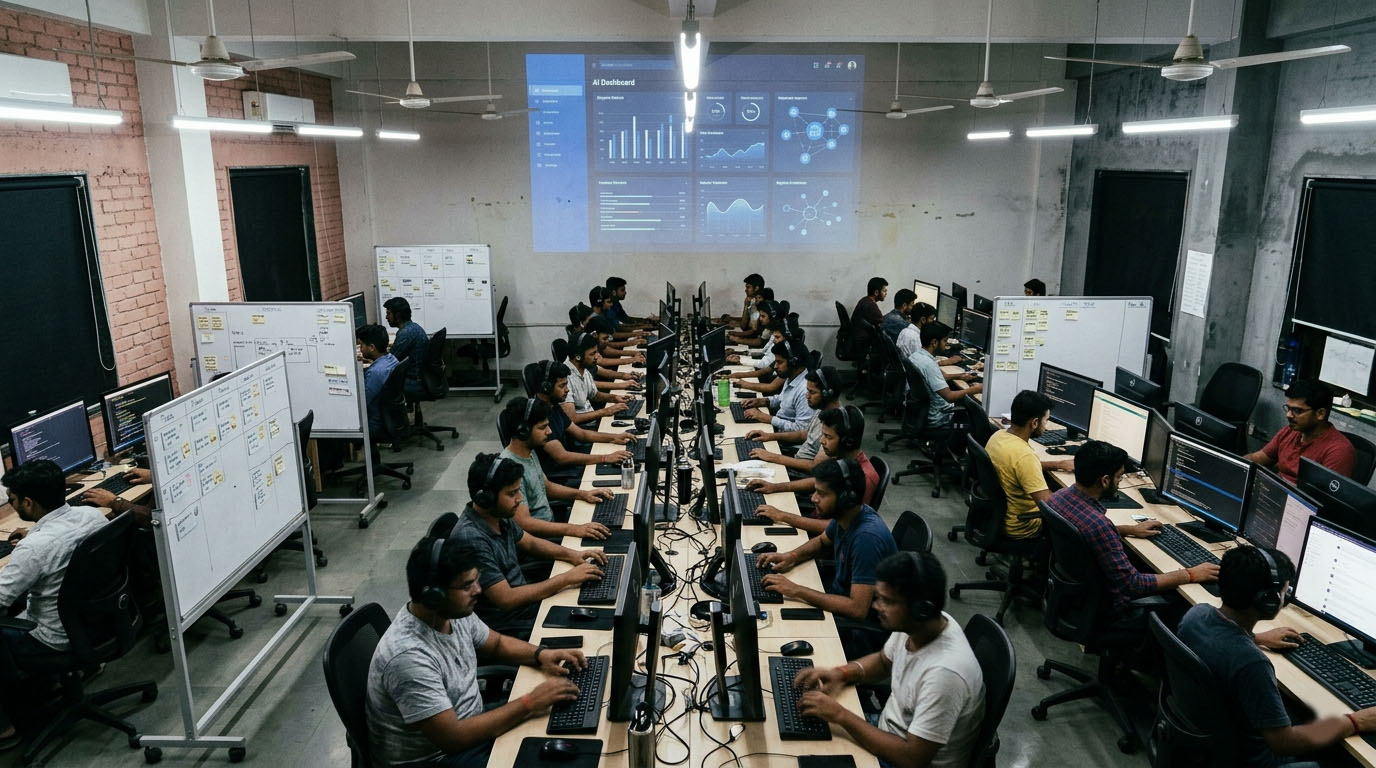
The reporting from inside the company over the years paints a fairly consistent picture. When a customer placed an order through Natasha, that order was routed to a project manager, broken down into tickets, and handed to human developers in India. Some former staff put the engineering headcount in the high hundreds, north of 700 by some accounts. Their job was to build the app the AI had supposedly designed.
The detail that stuck with me from the podcast, and that I later found in multiple reports, is the part about benchmarking against real LLMs. Once open source large language models started appearing, prospective enterprise clients began asking for evaluations. They wanted to see Natasha's outputs side by side with whatever Google or Meta had just open sourced. Builder.ai obliged. Internally, that meant the fastest engineers and typists on the floor were given the prompts and told to produce "Natasha's" answer as quickly as possible, polished, formatted, and dropped into the demo. Speed mattered, because real LLMs reply in seconds.
The Trick
For years it worked. The product shipped, even if it shipped late. Customers got apps. Investors saw revenue. The people doing the typing were paid less than the marketing budget for a single conference. And Natasha kept smiling on the website.
The cracks only started to show when proper LLMs got good enough that you could put a Builder.ai answer next to a fresh model output and notice that the fresh model was, somehow, more articulate, more accurate, and far cheaper.
The Money: Who Funded Natasha
This is the part I keep coming back to. The investor list reads like a Davos seating chart.
- SoftBank's DeepCore fund led a Series A in 2018, around $29.5M.
- Lakestar, Jungle Ventures, IFC, and others joined a Series B in 2018 to 2019, lifting total funding past $100M.
- Insight Partners led a $100M Series C in 2021.
- Qatar Investment Authority (QIA) led a Series D in 2023 of about $250M, with Microsoft joining the round and signing a strategic partnership.
Total raised across rounds ended up at roughly $450 million. The company was at one point valued at over $1 billion, putting it firmly in unicorn territory. Sachin Dev Duggal was named one of the leading entrepreneurs in AI. Builder.ai picked up "AI Company of the Year" type awards from outlets that, in hindsight, probably should have asked one more question.
The Microsoft tie up in particular gave Builder.ai a halo nothing else could buy. Microsoft is not a VC, Microsoft is the validation. Once Microsoft is on the cap table, every enterprise sales call gets easier.
The Warnings Nobody Wanted To Read
The first real public crack came in August 2019, when the Wall Street Journal ran a piece headlined "AI Startup Boom Raises Questions of Exaggerated Tech Savvy". The article quoted current and former employees saying Engineer.ai's product was "based on the work of human engineers" and that the AI claims were "untrue". A former chief business officer alleged in a lawsuit that the company had misled investors about how much of the work was AI driven.
The company denied everything, threatened legal action, and, remarkably, kept raising money for another six years. The 2019 story should have ended the company. Instead it was treated as a "growing pains" headline. The valuation kept climbing.
Towards 2024 to 2025, more serious allegations surfaced about round tripping revenue with another company, VerSe Innovation, the parent of Indian news app Dailyhunt. Reuters and Bloomberg both reported that the two companies had allegedly been billing each other for similar amounts to inflate revenue figures. Both companies denied the allegations. Auditors did not.
May 2025: The Lights Go Out

In May 2025, Builder.ai filed for insolvency. By that point the cash was gone, an audit had reportedly found revenue figures vastly overstated, and the lender Viola Credit had moved to seize what was left. Sachin Dev Duggal had stepped down as CEO earlier in the year, although he remained on the board. Microsoft and QIA wrote off their stakes. Around 1,000 staff lost their jobs across London, Los Angeles, Delhi, Singapore, Dubai, and other offices. The Natasha avatar disappeared from the homepage.
Subsequent reporting put the actual revenue at a small fraction of what had been claimed for the prior years. By the time bankruptcy hit, the unsecured creditor list ran into the hundreds of millions of dollars. Customers who had paid for app builds were left holding receipts. Engineers in India who had built those apps were laid off in waves.
There was no perp walk. No SEC indictment. As of writing, no criminal charges have been filed against Sachin Dev Duggal personally. The company is just gone.
The Builder.ai Blueprint, Or What This Actually Teaches Us
Strip the AI veneer off and Builder.ai isn't a story about technology. It's a story about confidence. The same psychological play Frank Abagnale Jr ran in the 1960s. Same play Elizabeth Holmes ran with Theranos. Same play any decent stage magician runs at a kid's birthday party. Convince the audience the trick is real, and the trick becomes real for as long as the lights are warm.
A few things from this case that I think every founder, investor, and engineer should sit with:
- "AI" was the magic word. If Builder.ai had said "we are an outsourcing shop with a slick UI", they would have raised a fraction of the money. The label drove the valuation, not the product.
- Due diligence is performative when the IRR is good. Top tier investors did real due diligence. They still got fooled. When everybody is making money, nobody wants to be the partner who killed the deal.
- Whistleblowers are early, not wrong. The 2019 WSJ piece was right. The lawsuit was right. The market chose to disagree for six years.
- If your AI's outputs are slower than a real LLM, you do not have an AI. Latency is the giveaway. Humans cannot match transformer inference speed at scale, no matter how fast they type.
The Quote That Fits
"If you act like you know what you're doing, you can do anything you want, except neurosurgery."
,, Sharon Stone, paraphrasing every con artist who ever lived. Builder.ai didn't even need the asterisk.
The unspoken rule of the modern con is the one Frank Abagnale used to repeat in interviews. "It's a matter of having the confidence and the courage to be who you say you are."
Or, in the spirit of how this whole industry actually works:
The Builder.ai Blueprint
Believe it about yourself first. Decide that you are the most leading AI company in the world. Make other people believe it next. Once you both believe, you can accomplish anything, and you can con anyone. That, in one paragraph, is how Sachin Dev Duggal turned a typing pool into half a billion dollars.
Honestly, the only thing more impressive than getting away with it is how quickly the industry pretended it never happened. Builder.ai's collapse barely moved AI valuations the next quarter. The next "Natasha" is already raising a Series B somewhere.
References & Further Reading
Sources I cross checked while writing this. Worth reading if you want the long form versions.
- Wall Street Journal (Aug 2019), AI Startup Boom Raises Questions of Exaggerated Tech Savvy the original expose of Engineer.ai's claims.
- Wikipedia, Builder.ai rolling timeline of funding rounds, controversies and the 2025 collapse.
- Reuters (May 2025), Microsoft backed Builder.ai files for insolvency the bankruptcy filing and creditor numbers.
- Bloomberg (Oct 2024), Builder.ai and VerSe Innovation revenue allegations on alleged round tripping with Dailyhunt's parent company.
- Financial Times (2023), Microsoft and QIA back Builder.ai $250M Series D the round that pushed total funding near $450M.
- TechCrunch (Aug 2019), Engineer.ai claims to build apps with AI, allegedly uses humans coverage of the original WSJ piece and the company response.
- CNBC (May 2025), The collapse of Builder.ai, what investors and customers lost the post mortem.